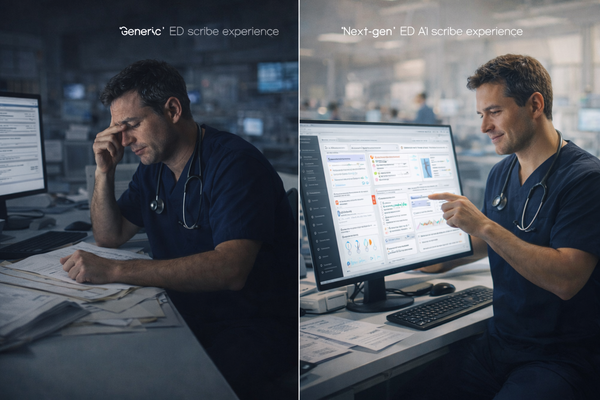
Reducing Post-Shift Charting in Emergency Medicine: A Practical Guide to Work-Life Balance with AI

If you have ever wrapped up a shift only to realize the real work is just beginning, you are not alone.
The department slows down. You drive home thinking you will finally decompress. Then you open your laptop and the chart queue is still waiting. The details are already fading. You are piecing together decisions made hours ago in the middle of constant interruptions.
Post-shift charting is not a personal productivity issue. It is documentation debt built into the structure of emergency medicine. If you are evaluating tools to reduce it, the goal is not faster typing. It is finishing accurate, defensible notes during the encounter so the work stays at the hospital and does not follow you home.
Why Charting After Hours Persists in Emergency Medicine
In clinic settings, documentation tends to be linear. A scheduled visit, a mostly uninterrupted conversation, and a predictable conclusion. The emergency department operates differently. Emergency physicians document across four overlapping realities that make it unrealistic to finish notes in real time:
Managing multiple patients
You are rarely focused on a single case. You are overseeing several patients, each at different stages of evaluation, reassessment, and disposition.
Care driven by interruptions
The problem is not forgetting what to write. It is being pulled into the next room, the next decision, the next critical moment.
Evolving narratives
The clinical picture shifts. Records arrive late. Family members add new information. Labs return after you have moved on to the next patient. Documentation is not a recap - it is a reflection of ongoing clinical reasoning.
Compressed timeframes
When volume surges, documentation gets deferred. Post-shift charting is what happens when that deferred work finally comes due.
The Hidden Costs of “Just Finishing Charts at Home”
In many departments, after-hours charting is treated as routine. Providers adapt to it. Leadership often overlooks it. But the impact shows up in areas that hospital administrators do care about.
The Clinical Cost: Cognitive Fatigue and Fading Details
Charting at home pushes documentation into a lower-fidelity environment. You are tired. The encounter is no longer fresh. Subtle but important details - especially the reasoning behind your decisions - become harder to reconstruct.
This is not about checking a box. It is about documenting clinical thinking, uncertainty, and nuance in a way that reflects the care you actually provided.
Compliance and Revenue Integrity: Two Sides of the Same Problem
Late documentation often leads to templated or abbreviated notes. The result is a chart that does not fully reflect the complexity of the encounter. That creates two predictable outcomes:
- Revenue loss when the note does not justify the level billed
- Compliance risk when documentation lacks detail on data reviewed, risk assessed, and decisions made
Want to understand the full impact? Read how documentation gaps lead to financial losses and compliance exposure.
The Retention Cost: The Second Shift That no one Accounts For
After-hours charting is unpaid work that cuts into recovery. Even one hour per shift takes time from sleep, family, exercise, or mental decompression. Over time, that tradeoff erodes job satisfaction and increases turnover. Provider experience is not a soft metric. It is a leading indicator of operational stability.
Why “Typing Faster” Misses the Point
When departments try to reduce after-hours charting, the first instinct is often to reach for tools that improve speed, dictation, templates, EHR shortcuts, or scribes. These options can offer some relief, but they rarely solve the underlying problem in a high-volume emergency department.
Dictation improves speed but not thinking
Dictation reduces typing effort, but it does not reduce the mental work required to assemble a clear and complete note. Most clinicians still spend time editing, organizing, and adding context afterward.
Templates create structure but can reduce clarity
Templates help standardize documentation, yet they often shift the focus toward checklists rather than clinical reasoning. This can lead to lengthy notes that are technically complete but still fall short in supporting billing or audit requirements.
Scribes reduce workload but bring operational tradeoffs
Human scribes can offload some documentation, but they come with limitations. Coverage gaps, training demands, turnover, and inconsistent quality can make them difficult to scale. More importantly, scribes document what was said and done but do not ensure the chart includes the decision-making details needed for coding accuracy or audit defensibility.
What Actually Reduces Charting Time in the ED
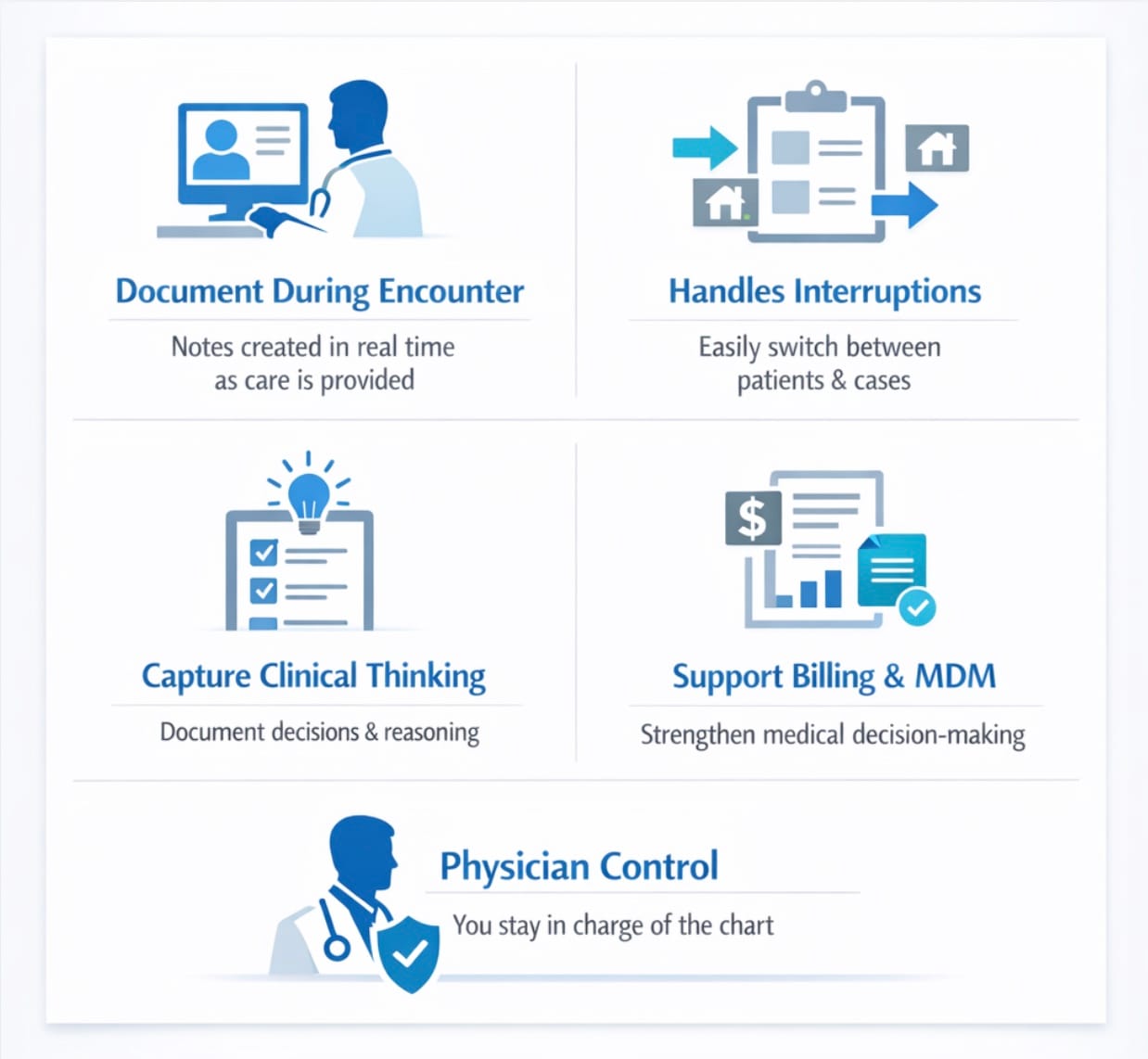
When evaluating solutions, the focus should be on solving real workflow challenges rather than comparing feature lists. After-hours charting decreases when documentation is generated during the encounter and only requires light review before signing.
Here are five criteria that matter in emergency medicine:
1. Documentation begins during the patient encounter
If the note is drafted in real time as care unfolds, review becomes faster and more accurate.
2. It supports interruptions and patient switching
A useful tool must hold up in a multitasking environment. If it breaks when you move rooms or switch cases, it becomes another system to manage instead of reducing documentation debt.
3. It captures clinical reasoning, not just a transcript
An ED note is not a summary of what was said. It is a record of clinical decisions made. What you considered, what you ruled out, and why a specific course was chosen.
4. It strengthens medical decision-making documentation and billing support
Many tools stop at structural completeness. But a note can be complete and still fail to justify the level billed. If physicians do not trust that the chart reflects complexity and medical necessity, they will keep editing it after the shift.
5. Physicians stay in control
Tools that feel like they are replacing judgment rather than supporting it will fail to gain traction. The right solution enhances clinical reasoning without interfering with how decisions are made.
Where AI Helps and Where It Falls Short
AI can meaningfully reduce after-hours charting, but only when it is used in ways that reflect the realities of emergency medicine.
What helps: ambient documentation that captures care in real time
Ambient systems reduce the need to reconstruct the encounter later. The clinician’s role shifts to reviewing, refining, and completing the note instead of rebuilding it from memory.
What falls short: transcription without context
Transcription alone may increase the review workload. A long transcript is not the same as a coherent, defensible note and often requires significant editing to align with documentation and billing standards.
What helps: real-time chart feedback that closes the loop
Many after-hours edits happen because clinicians are unsure whether their documentation supports the clinical story, the risk level, or the billing code. When a system identifies missing components clearly and in context, it helps clinicians avoid second-guessing and last-minute rework.
Health records carry a significant documentation burden that contributes to clinician workload and after-hours work, with time spent on electronic documentation and related tasks constituting a key driver of clinician stress and administrative time.
A Different Approach: AI as an ED CoPilot, Not Just a Typing Tool
The criteria above point to a specific category of solution. This is where an ED CoPilot approach is meaningfully different from a general scribe or transcription tool.
DocAssistant is built specifically for emergency medicine, with three linked capabilities that directly address the pain points driving after-hours charting:
1. Ambient AI scribing designed for interruption-driven care
The goal is to capture the encounter in real time so clinicians are not left reconstructing notes at the end of the shift. The system works in the background and keeps pace with the non-linear, multi-patient nature of ED care.
2. Transparent, evidence-linked clinical guidance
DocAssistant surfaces relevant recommendations during documentation, linking directly to sources like StatPearls, PubMed, and WikEM. This not only supports confident clinical decision-making but also makes guidance easy to audit and cite within documentation.
3. Chart-level billing and MDM analysis
This is the key differentiator for departments looking to reduce documentation debt without increasing audit risk. The chart-level analyzer provides specific feedback on what needs to be included to support appropriate billing levels. This helps prevent the “I should go back and fix the note” behavior that commonly leads to after-hours work.
What This Looks Like in the Real World
Most departments want to know whether this actually changes life after the shift, not just how the note looks.
This is also what internal champions need. A “work-life balance” improvement becomes much easier to justify when it comes with measurable operational results such as time savings, revenue integrity, and reduced compliance exposure.
In a case study with Elite Hospital Partners, DocAssistant was associated with an 85 percent reduction in emergency charting time and $399,000 in recovered revenue per provider per year. The reason this matters for after-hours charting is simple: when documentation debt decreases during the shift and MDM support improves, clinicians stop bringing charts home.
Implementing Change Without Disrupting the Department
Even the right tool can fail if the rollout creates unnecessary friction. A low-risk implementation strategy focuses on testing how well the solution fits the department’s real needs.
Pilot to prove outcomes, not just to test software.
Track metrics that reflect meaningful impact:
- After-hours charting time per clinician per shift
- Same-day note completion rate
- Provider satisfaction and perceived cognitive load
- Coding distribution changes that reflect improved documentation (without signs of inappropriate upcoding)
- Denials or audit-related feedback, if available
Choose a representative pilot group.
Include a high-volume clinician, someone who is skeptical, and a provider who often finishes charts at home. If it works for that mix, it is more likely to work across the department.
Address governance up front.
Department leaders will ask about data security, documentation accuracy, and clinical control. Adoption improves when these concerns are built into the plan early rather than addressed after resistance has already formed.
Getting Your Evenings Back Without Lowering the Bar
Post-shift charting is often accepted as the cost of delivering quality care. It does not have to be.
The practical solution is to reduce documentation debt during the shift, capture clinical reasoning clearly, and ensure notes are defensible so that providers are not revisiting charts late into the night.
If you are evaluating solutions, focus on the criteria that actually reduce after-hours charting in emergency medicine:
- Supports documentation during care, not after
- Handles interruptions and patient transitions without breakdown
- Preserves clinical reasoning, not just captures words
- Improves MDM quality and billing defensibility
- Keeps clinicians in control of the process
If you are considering DocAssistant, the best next step is a brief pilot focused on three things: after-hours charting time, documentation quality, and defensibility. A workflow review or demo should be structured around confirming fit against these criteria rather than sitting through a generic product walkthrough.
About the Author
Nathan Murray, M.D. Emergency Medicine - Founder of DocAssistant
Dr. Nathan Murray is an Emergency Medicine trained physician and the founder of DocAssistant. With years of frontline clinical experience, Dr. Murray is passionate about using AI to streamline medical documentation and enhance clinical decision making.