
How Contextual Understanding Sets Next-Gen AI Scribes Apart
Generic AI scribes transcribe words. Next-gen AI scribes understand clinical context. Learn the 5 capabilities that separate surface transcription from deep contextualization.

Generic AI scribes transcribe words. Next-gen AI scribes understand clinical context. Learn the 5 capabilities that separate surface transcription from deep contextualization.
DocAssistant has launched a free AI-powered ICD-10 database that helps billing teams and clinicians find the right codes using plain-language clinical terms - no login required.

High-volume emergency departments see $399K additional revenue per physician annually with AI scribes. Real case data shows 85% charting time cuts and measurable ROI.
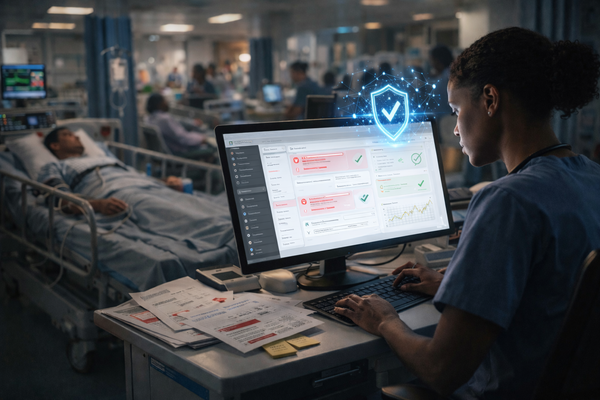
Emergency department documentation errors cost hospitals millions annually. Learn the 5 most expensive error types and how AI prevents revenue loss.

Why emergency medicine needs EM-specific AI, not generic tools. Learn how specialty training data and domain expertise impact clinical AI performance in EDs.

Most ED leaders understand that AI scribes have the potential to reduce charting burden. The real question is whether they will work in your department, with your physicians, and within your operational constraints. A failed pilot doesn’t just cost money. It erodes physician trust in new technology, creates skepticism

If you have ever wrapped up a shift only to realize the real work is just beginning, you are not alone. The department slows down. You drive home thinking you will finally decompress. Then you open your laptop and the chart queue is still waiting. The details are already fading.

Artificial intelligence has entered many industries, including healthcare. In medicine, AI helps improve accuracy, enhance patient safety, reduce workload, and support faster clinical decisions. It is also becoming increasingly important in managing administrative tasks. In the fast-paced environment of the emergency department, these capabilities are especially valuable for improving patient
Clinician-Built AI Scribe Platform Demonstrates Year-Long Commitment to Industry-Leading Security Standards San Diego, California – January 3rd, 2025 – DocAssistant, the comprehensive AI-powered scribe, clinical decision support, and point-of-care RCM solution designed specifically for Emergency Departments and Hospitalists, today announced it has successfully achieved SOC 2 Type 2 certification. This milestone underscores
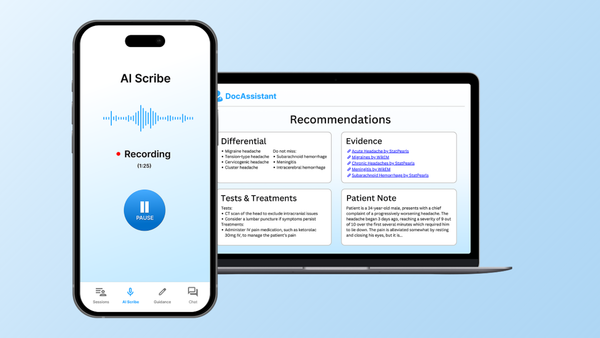
Elite Hospital Partners found that their Emergency Medicine physicians that used DocAssistant's HIPAA-compliant AI scribe and Clinical Decision Support Tool reduced charting time by 85% while capturing an average of $399,168 in additional annualized revenue per physician through more complete clinical documentation. "Emergency physicians spend way

Background Elite Hospital Partners partnered with DocAssistant to evaluate the financial and operational impact of AI-generated clinical documentation in the emergency department. Objective The core objective was to improve physician documentation quality in alignment with the 2023 CMS Evaluation & Management (E/M) guidelines, thereby capturing the full value of

In this guide, we'll examine the current AI scribe landscape, analyze why popular platforms struggle in emergency medicine environments, and explore the key factors you should consider when evaluating documentation tools for the ER.

Imagine walking into your clinic and being met not by a stack of paperwork, but by the opportunity to focus more fully on your patients. Research shows that clinicians now spend more time documenting than engaging with those they care for (Ammenwerth and Spötl, 2009). This growing challenge has sparked

In today’s fast-paced healthcare environment, clinicians are expected to see more patients, handle less paperwork, and still deliver high quality care while managing stress and avoiding burnout. That is where AI medical scribes come in. These digital tools automatically capture and organize clinical notes, easing the documentation burden. As

Believe it or not, the scribe profession dates back thousands of years, nearly as far as the invention of writing itself. Historians note that scribes in ancient Egypt and Mesopotamia were highly educated individuals responsible for recording events and managing administrative duties. These scribes often belonged to the upper tiers

Electronic Health Records are now a core part of modern healthcare, used by more than 90 percent of hospitals and nearly 90 percent of private practice physicians in the United States, as of 2021. These systems make it easier to store and access patient information, improving the organization of medical

The healthcare industry is undergoing a major transformation, driven by rapid advancements in technology. Among the most impactful innovations is the emergence of AI medical scribes, digital tools designed to streamline clinical documentation and reduce the administrative burden on physicians. These systems are reshaping how medical professionals manage patient records,

In today’s healthcare environment, physicians are responsible for much more than diagnosing and treating patients. A substantial portion of their time is spent entering information into Electronic Health Records. Research shows that many doctors now spend more time on documentation than with patients, contributing to dissatisfaction and burnout. To

Today’s healthcare professionals have a wide range of responsibilities. In addition to providing high-quality patient care, they must also ensure accurate documentation, compliant billing, and adherence to regulatory standards, all of which can be time-consuming and complex. Advancements in technology are beginning to ease this burden. AI-powered medical documentation

The Benefits of Combining AI Medical Scribes with Clinical Decision Support Worldwide, healthcare systems have been experiencing a significant rise in patient volume and administrative workloads requiring more frequent and faster clinical decision making over the last several decades. Luckily, emerging technologies like artificial intelligence are offering solutions to these

The advent of a major technological revolution has been transforming a wide range of industries across the globe. Artificial intelligence (AI) is creating buzz worldwide and revolutionizing the entire process of how organizations function. It has transformed several clinical procedures by leaving significant impressions on the healthcare system. AI scribes

Doctors and nurses spend a lot of time on documentation, often taking them away from patient care. Fortunately, AI Scribes can help! They do this by transcribing conversations and offering clinical recommendations automatically allowing healthcare staff to focus more on their patients instead of paperwork. And unlike traditional human scribes,

Documenting clinical records is a tedious task, and more often than not, has to be handled by doctors or midlevels (NPs/PAs). This is a well documented problem. A 2024 report shows about 49% of physicians said they were burned out. The same study reveals the number one cause for