
The True ROI of AI Scribes in High-Volume Emergency Departments
High-volume emergency departments see $399K additional revenue per physician annually with AI scribes. Real case data shows 85% charting time cuts and measurable ROI.

High-volume emergency departments see $399K additional revenue per physician annually with AI scribes. Real case data shows 85% charting time cuts and measurable ROI.
Emergency Medicine
Emergency department documentation errors cost hospitals millions annually. Learn the 5 most expensive error types and how AI prevents revenue loss.

Why emergency medicine needs EM-specific AI, not generic tools. Learn how specialty training data and domain expertise impact clinical AI performance in EDs.

Most ED leaders understand that AI scribes have the potential to reduce charting burden. The real question is whether they will work in your department, with your physicians, and within your operational constraints. A failed pilot doesn’t just cost money. It erodes physician trust in new technology, creates skepticism

If you have ever wrapped up a shift only to realize the real work is just beginning, you are not alone. The department slows down. You drive home thinking you will finally decompress. Then you open your laptop and the chart queue is still waiting. The details are already fading.

Artificial intelligence has entered many industries, including healthcare. In medicine, AI helps improve accuracy, enhance patient safety, reduce workload, and support faster clinical decisions. It is also becoming increasingly important in managing administrative tasks. In the fast-paced environment of the emergency department, these capabilities are especially valuable for improving
Clinician-Built AI Scribe Platform Demonstrates Year-Long Commitment to Industry-Leading Security Standards San Diego, California – January 3rd, 2025 – DocAssistant, the comprehensive AI-powered scribe, clinical decision support, and point-of-care RCM solution designed specifically for Emergency Departments and Hospitalists, today announced it has successfully achieved SOC 2
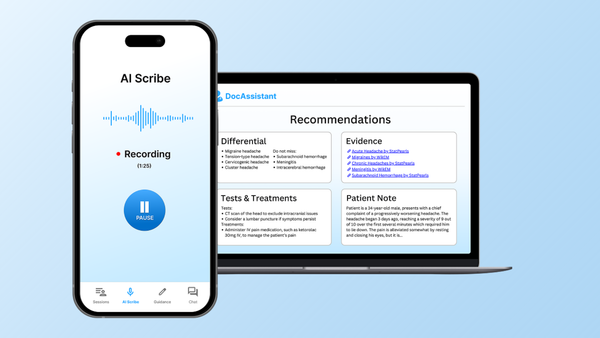
Elite Hospital Partners found that their Emergency Medicine physicians that used DocAssistant's HIPAA-compliant AI scribe and Clinical Decision Support Tool reduced charting time by 85% while capturing an average of $399,168 in additional annualized revenue per physician through more complete clinical documentation. "Emergency physicians spend

Background Elite Hospital Partners partnered with DocAssistant to evaluate the financial and operational impact of AI-generated clinical documentation in the emergency department. Objective The core objective was to improve physician documentation quality in alignment with the 2023 CMS Evaluation & Management (E/M) guidelines, thereby capturing the full value

In this guide, we'll examine the current AI scribe landscape, analyze why popular platforms struggle in emergency medicine environments, and explore the key factors you should consider when evaluating documentation tools for the ER.

Imagine walking into your clinic and being met not by a stack of paperwork, but by the opportunity to focus more fully on your patients. Research shows that clinicians now spend more time documenting than engaging with those they care for (Ammenwerth and Spötl, 2009). This growing challenge has sparked